Tuesday, October 29, 2019

Wildfires and Worries

Over the summer of 2013 my wife Linda and I took a trip out to the west coast.  While we were there we came close to wildfires burning in northern California and threatening redwoods.  I have thought of that trip more than once over the last few days, and remembered a poem I wrote at the time.  I share it with you this week.


WILD WOODS, WILD FIRES

I.

Ancient trees,
Planted before nation
Planted before Calvin and Muslims and Caesar Augustus,
Planted by wind or chance,
Older than dirt
That holds them up.

II.

"They're twenty-five miles away,"
The waitress says
Laying down our burgers and slaw.
"Somedays the smoke here's so thick
You have to put a hankie to your face."

And then she leaves to wait on others
As if burning forests
Were just one more way
To pass time with tourists.

You can tell, though,
She's worried.

--John H. Danner
(This poem originally appeared in the Island Sun)

A poem, and our prayers for the trees, the animals and the people
in the paths of the fires.

Tuesday, October 22, 2019

Saved on Boston Common


I've been thinking about some of the folks who have served as mentors to me over the years.  And one of them was Dr. Earl Kent Brown.  Kent was my First Reader on my PhD dissertation, and a very wise soul.  

I went to Boston University, and Kent lived just down the street from the main part of that massive urban campus.  He didn't own a car, and did a lot of walking all over that great city.  

In the heart of Boston one finds the Common.  Centuries back it was the grazing ground for cows and sheep owned by Bostonians.  Today, it is the gathering space for all sorts of people.  Clowns and musicians; business folk on lunch break; street people hoping for a scrap of lunch teenagers on skateboards, runners, sunbathers and just plain walkers, like my friend Kent.

One also finds there a wider assortment of religious and political views.  Hare Krishnas will invite you to a vegetarian dinner at a nearby ashram; conservatives will offer you a red hat; some local politician is bout to want to shake your hand and assure your vote; and often a clean-cut Christian young man or woman will approach you with the question, "Have you been saved?"

Now my friend Kent was as liberal as Methodists ever get.  He was also one of gentlest, kindest, most Christ-like folk I have ever known.  He devoted his life to being a teacher of the Church.  He stood about 6'6" and must have weighed close to 300 pounds.  Maybe he didn't look saved--whatever the case, more often than not, when Kent would walk through the Common one of those clean-cut kids would approach him and ask, "Have you been born again? Have you been saved?"

Inevitably the questioner had in mind a very particular understanding of what it means to be born again, to be saved.  No doubt exists in my mind that Kent Brown was a committed follower of Jesus.  But his understanding of what that means would probably be too loosely defined for his questioner.  And so, when asked, "Have you been saved," rather than get involved in a long debate, he would simply respond, "Yes, two thousand years ago."

I miss Kent--and am grateful he was a part of my life!

Tuesday, October 15, 2019

Thank You, Rex

A friend of mine died in the past few days.  Not a real close friend, but a friend nonetheless.  We would run into each other a couple of times a month, but we didn't socialize together.  I suppose some might even use the word acquaintance to describe our relationship to one another.

Whatever the case, the thing I most valued about my friend was his sense of humor, and his willingness to share that humor with others.  He was a big fan of puns, and on a daily basis he would post a cartoon on Facebook that usually involved some sort of wordplay.  One of his last postings showed two chickens standing in front of a barn.  One of them is wearing a kilt (quite the image!)  "Yes," says the kilt-wearing bird, "I went on Ancestry.com to do some research and discovered I'm Scottish.  In fact, my family is part of the McNugget clan."   When I saw that I literally laughed out loud.  And over the course of the next couple of days, shared it with a number of folks.

My friend will be missed by many people for all sorts of reasons.  Things far more important in some ways than cartons and puns.  But even those of us on the fringes of his life will miss the way he was able to bring a bit of light and a touch of humor to each day.  I will do well to not only remember that in the days ahead, but to emulate it as well.

So, did you hear the one about the chicken that crossed the road?

Monday, October 7, 2019

Is There Room for Mercy?

Do you remember the Tree of Life Synagogue shootings last year in Pittsburg?  Eleven Jews were killed by Robert Bowers in an act of pure anti-Semitism.  It was horrific.

The federal government, which is prosecuting the case as a hate crime, has declared that it will be seeking the death penalty for Bowers.  But two of the three congregations have issued statements declaring their opposition to the plan.  The third congregation has taken no stand on the matter.  It is not that any of the congregations feel Bowers should go unpunished, just that the penalty should be life in prison without the possibility of parole as opposed to the death penalty.

I thought of this as I was reflecting on the powerful scene from the closing moments of the Amber Guyger trial, as the brother of Botham Jean, the unarmed man she had murdered offered her very public words of forgiveness and an embrace, even as others outside the courtroom protested the ten-year prison sentence the former police officer was given as being too lenient.

Both stories prompt the same question:  what is the role of mercy in our society?  And how do we balance justice and mercy?  I have always considered justice to be getting what we deserve, and mercy as a granting of undeserved grace.  Bowers, it would seem, deserves to pay the highest price for his crime.  That would be just. Guyger deserves to be severely punished for her crime.  That too would be just.  But what part can, should, mercy play in a court of justice?  

The scriptures--Jewish, Christian and Islamic alike--speak of God as being both just and merciful.  If we are called to be reflect God's will and way, then we too should be both--but how do we do that?    

Tuesday, October 1, 2019

Books, Glorious Books!

I got a text today from my daughter Elizabeth which included this picture.  "First day setting up my new digs," it read.  Her new "digs" is a newly constructed library in Cambridge, Massachusetts.  It is part of the Cambridge Public Library System.  Three years ago the old building where the new library now stands was torn down in anticipation of the new structure.  So, over the last three years, some of its collection of books ahs been in storage, and Liz has been wandering, working in other branches.  But now, finally, she gets to go home.

Liz is a children's librarian, a graduate of Simmons University, from one of the country's finest library science (or as it is often now called information science) programs.  She is well-trained and well-experienced.  She knows all about the ins and outs of the Dewey decimal system and Google and computers and all that stuff.  But mostly she loves books.  Books and kids.  She loves to help a child discover a new author or dig more deeply into the oeuvre of an old  favorite.  She does story times, and summer reading programs and even slumber parties at the library (what a saint!)

I am so glad the children of Cambridge have Liz in their lives.  Because having Liz means  they will be exposed to the wondrous world of literature, and the joy of reading.

I just got back from vacation myself, and managed to work my way through a ton of reading while I was gone.  A presidential biography, a volume on meditation, a couple of novels, a book about maintaining boundaries, another on twelve-step spirituality and Barbara Brown Taylor's latest volume called Holy Envy.  All were terrific!  I didn't have a Liz when I was a kid, but I did have teachers and parents who encouraged me to read.  And for that I am so very grateful.

Good luck in your new digs, Liz!  And keep those kids reading!

(Photo:  Shelves in the children's section of the Valente Branch Library, Cambridge, MA)

Tuesday, September 24, 2019

325 Square Feet: A Word about Immigration

The Tenement Museum in New York's Lower East Side is devoted to telling the story of immigration.  Or maybe I should say stories.  For this tour-based museum purchased a tenement building at 97 Orchard Street in 1988, and has used it to tell the stories of a number of different immigrant families who once lived there.

The apartment we explored on my tour, called "Hard Times," focused on two families, one a German Jewish family who came to the United States in the mid-nineteenth century, and a Italian Roman Catholic family that lived in the same apartment decades later in the early twentieth century.  Both families lived through very trying times financially--the Depression of 1873, and the Great Depression of the Thirties.  Hence, the tour's name:  "Hard Times."

Our tour guide did a fine job bringing their stories to life.  She spoke of a husband who abandoned his family when he couldn't find work, another husband who kept the home fires burning after he lost his job, and two wives who stepped up to the challenge of supporting their families.  She told us about one family playing games on the kitchen table, and both families using outhouses in the tiny backyard.

The apartment they lived in was 325 square feet.  One bedroom, a parlor and the kitchen--shotgun style.  When the German family lived there it housed six.  It struck a real chord because throughout my high school years, my family of six lived in a very similar apartment--both in terms of square footage, and layout.  No outhouse--we did have indoor plumbing.  And electricity.  But still--it was tight.  I can only imagine what it would have been like if it had been as stripped down as the tenement apartment on Orchard Street.

Of course, there are many, many stories of much larger families, extended families, living in such places.  Not just in the past, but today.  Right here in the United States.  It is amazing, isn't it, what difficult conditions people will endure for a chance at freedom, a chance for opportunity.  There can be little question (at least in my mind) that immigrants, then and now, provide real strong threads when they are woven into our national fabric.  Might we never forget that as we debate the future of so many folks looking for what many of our ancestors longed for--and found--in times past.

Tuesday, September 17, 2019

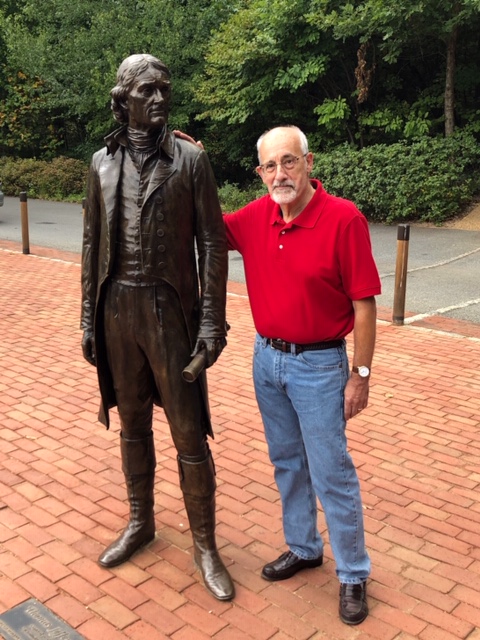
Thomas Jefferson and Me

Our travels have taken us to the Shenandoah Valley in Virginia.  It is a gorgeous part of the country.  And today we visited Monticello, the home of Thomas Jefferson.  Our tour guide was excellent, and offered many insights into the house and the man who built it.  Well, figuratively speaking.  The actual construction, following Jefferson's instructions and architectural plan, was executed by the many hired workers and enslaved people who were owned by the third president.  And therein, of course, lies the rub.

The master of Monticello is best known for penning the stirring words in the Declaration of Independence. "We hold these truths to be self-evident," wrote Jefferson, "that all men are created equal, that they are endowed by their Creator with certain unalienable Rights . . . ."  All the while he owned well over six- hundred slaves over the course of his lifetime, emancipating only a few over the years, including the children of his slave mistress Sally Hemings.

That part of the Jefferson story has only been told at Monticello since the nineties.  Indeed the Hemings story, which is now highlighted on the estate, as well as in the narratives of the tour guides, was denied at Monticello until relatively recently.

To this day, of course, there are still those who would have us ignore our own history.  There are those who think we should just set aside any references to slavery (not to mention reconstruction, the Jim Crow era, and so on.)  But the sad truth racism is a very real part of our history.  America's "original sin," as various scholars have noted.  And our past is enormously complicated.  It is a mixture of the very best of human strivings and ideals, and that which is nothing short of abhorrent.  And we often find both in individuals, like Jefferson, as well as in society at large.

Our tour guide suggested that it is important that are honest in our approach to history, acknowledging the good and the bad.  And maybe, just maybe, we can learn something from it so that the mistakes of the past are not repeated.  True enough.  And today I am asking myself what can I learn from the story of Thomas Jefferson?  

(Photo:  Statue of Thomas Jefferson at Monticello.  Courtesy Linda Bradbury-Danner)