Tuesday, September 24, 2019

325 Square Feet: A Word about Immigration

The Tenement Museum in New York's Lower East Side is devoted to telling the story of immigration.  Or maybe I should say stories.  For this tour-based museum purchased a tenement building at 97 Orchard Street in 1988, and has used it to tell the stories of a number of different immigrant families who once lived there.

The apartment we explored on my tour, called "Hard Times," focused on two families, one a German Jewish family who came to the United States in the mid-nineteenth century, and a Italian Roman Catholic family that lived in the same apartment decades later in the early twentieth century.  Both families lived through very trying times financially--the Depression of 1873, and the Great Depression of the Thirties.  Hence, the tour's name:  "Hard Times."

Our tour guide did a fine job bringing their stories to life.  She spoke of a husband who abandoned his family when he couldn't find work, another husband who kept the home fires burning after he lost his job, and two wives who stepped up to the challenge of supporting their families.  She told us about one family playing games on the kitchen table, and both families using outhouses in the tiny backyard.

The apartment they lived in was 325 square feet.  One bedroom, a parlor and the kitchen--shotgun style.  When the German family lived there it housed six.  It struck a real chord because throughout my high school years, my family of six lived in a very similar apartment--both in terms of square footage, and layout.  No outhouse--we did have indoor plumbing.  And electricity.  But still--it was tight.  I can only imagine what it would have been like if it had been as stripped down as the tenement apartment on Orchard Street.

Of course, there are many, many stories of much larger families, extended families, living in such places.  Not just in the past, but today.  Right here in the United States.  It is amazing, isn't it, what difficult conditions people will endure for a chance at freedom, a chance for opportunity.  There can be little question (at least in my mind) that immigrants, then and now, provide real strong threads when they are woven into our national fabric.  Might we never forget that as we debate the future of so many folks looking for what many of our ancestors longed for--and found--in times past.

Tuesday, September 17, 2019

Thomas Jefferson and Me

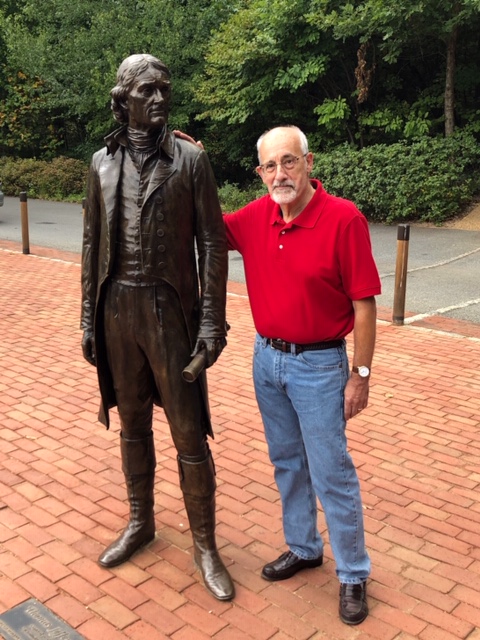
Our travels have taken us to the Shenandoah Valley in Virginia.  It is a gorgeous part of the country.  And today we visited Monticello, the home of Thomas Jefferson.  Our tour guide was excellent, and offered many insights into the house and the man who built it.  Well, figuratively speaking.  The actual construction, following Jefferson's instructions and architectural plan, was executed by the many hired workers and enslaved people who were owned by the third president.  And therein, of course, lies the rub.

The master of Monticello is best known for penning the stirring words in the Declaration of Independence. "We hold these truths to be self-evident," wrote Jefferson, "that all men are created equal, that they are endowed by their Creator with certain unalienable Rights . . . ."  All the while he owned well over six- hundred slaves over the course of his lifetime, emancipating only a few over the years, including the children of his slave mistress Sally Hemings.

That part of the Jefferson story has only been told at Monticello since the nineties.  Indeed the Hemings story, which is now highlighted on the estate, as well as in the narratives of the tour guides, was denied at Monticello until relatively recently.

To this day, of course, there are still those who would have us ignore our own history.  There are those who think we should just set aside any references to slavery (not to mention reconstruction, the Jim Crow era, and so on.)  But the sad truth racism is a very real part of our history.  America's "original sin," as various scholars have noted.  And our past is enormously complicated.  It is a mixture of the very best of human strivings and ideals, and that which is nothing short of abhorrent.  And we often find both in individuals, like Jefferson, as well as in society at large.

Our tour guide suggested that it is important that are honest in our approach to history, acknowledging the good and the bad.  And maybe, just maybe, we can learn something from it so that the mistakes of the past are not repeated.  True enough.  And today I am asking myself what can I learn from the story of Thomas Jefferson?  

(Photo:  Statue of Thomas Jefferson at Monticello.  Courtesy Linda Bradbury-Danner)

Tuesday, September 10, 2019

Georgia--and God--On My Mind

Linda and I are vacationing in the mountains of Georgia--beautiful country!  Somehow it seems appropriate that in my effort to read a biography of every president in chronological order that I am now in the midst of reading Redeemer, by Randall Balmer.  It is a very interesting take on Carter's life story, emphasizing his well-known devotion to his evangelical faith.

I was especially taken by a story referenced by Balmer in the section of the book I read this morning.  It was originally told by Carter himself in his book of meditations called Sources of Strength.

In the late sixties Carter had a renewed sense of dedication to his Christian convictions.  As a result he undertook two missions in 1968, going for a week to Loch Haven, PA and then later to Springfield, MA, to do door-to-door evangelism.

In Springfield he was paired up with Eloy Cruz, a Cuban-American pastor from Brooklyn.  Their assignment was to work with Puerto Ricans who had settled in Springfield.  Carter was very impressed with Cruz and his ability to connect with people.  Carter asked him how he was able to be so effective.  Finally, the somewhat reticent Cruz said, "Senor Jimmy, we only need to have two loves in our lives:  for God and for the person who happens to be in front of us at the time."  (Sources of Strength, xvii)

Now that's something to ponder while I'm here in the mountains of Carter's home state!

Tuesday, September 3, 2019

Waffles, the Church and Hope

They are ubiquitous in our neck of the woods.  Almost every interstate interchange has one.  The bright yellow sign is unmistakable.  Waffle House.  The food is predictable, if not especially fancy.  The prices are reasonable.  And the servers are like diner waitresses of old--always ready to call you "honey" or "sweetie"!  And, according to an article in our local newspaper this morning, Waffle House restaurants are a reliable sign of how a community has fared in the face of natural disasters like hurricanes and tornadoes.

It seems local, regional and even federal officials call it the Waffle House Index.  If an area has basically escaped the worst of a storm's impact, Waffle Houses are up and running within hours.  If they are open with a limited menu, it means there has been a certain amount of damage.  And if the local Waffle House is closed, then a community has been devastated.

All this is due to the fact that the folks at Waffle House have a well-thought out and predictable well-executed plan for preparing and responding to the likes of Hurricane Dorian.  Specially trained people, a stock of appropriate equipment, and so on.

One of the people interviewed in the article said that an open Waffle House means "the community has hope . . . It means things might actually be alright.  It's like the sunrise after the storm."  (The News Press, 9-3-19, 9-A)

It is my prayer that the church be thought of in just that way.  It is my prayer that the church be seen as a sign of hope, as a sunrise after the storm.  And in partnership with other public and private institutions, it is my prayer that we will continue to respond to those in need with compassion and assistance.

Friday, August 30, 2019

Now You See It . . .

Now you see it . . .  now you don't!  That's the way it works with Mount Rainier in Washington State.  While it is only eighty miles from  Seattle, and over fourteen-thousand feet in elevation, it is visible from the city a mere 90 days a year.  Pollutants, fog and other atmospheric realities obscure it the rest of the time.  It is very similar with Mount Hood, outside of Portland, Oregon.

Linda and I had the good fortune of viewing both mountains on our trip this week to the Pacific Northwest.  But we just as easily could have missed the sight of either or both and their magnificent, snow-covered peaks!

I got to thinking the simple yet profound theological statement both mountains seem to be making--at least analogically.  For God seems to often work in exactly the same way.  Now you see him (her) . . . now you don't.  Some days the hand of a good and loving God is readily apparent as one makes her or his way through life.  Those times when one sees a beautiful sight like Rainier or Hood is a good example of such days.  Clearly, there is a creative force behind such wonders!

Yet other days, when the human tendency to obscure and abuse the planet is most obvious, one can't help but wonder, where is divinity in all this?

But here's the kicker.  Even if we had not seen either of the mountains, I would have believed they were both there.  And so it is with God.  Even when God is obscured, seemingly absent, not in my line of vision, the mountains remind me that God is present.  And that, in a word, is faith.

I look unto the hills--
From where does my help come?
My help comes from the Lord
who made heaven and earth!
--Psalm 121 


Monday, August 19, 2019

I Was a Teenaged Evangelist

I was a teenaged evangelist.  I know, for some of you that is scarier than if I had said I was a teenaged werewolf.  But it's true.  I was a teenaged evangelist.  A street evangelist, to be more exact.  One summer, back in the late sixties, I was part of a group of high school and college aged kids who went at at nigh to witness to their faith.  We would first gather at the beachside cottage of a youth pastor named Dick and hear a word of encouragement.  Then we would pray that God would lead us to those who needed to hear the good news on that particular night.  After that we fanned out in pairs, walking up and down the boardwalk at Hampton Beach, looking for souls who looked in need of our message of salvation.  And when we had identified such a person, when we felt we were being nudged by the Spirit in a particular direction, we would walk up to them and ask if they knew about Jesus.

Fifty years later, as I look back on that summer, I am both dismayed and impressed.  I am dismayed about the nature of my theological understandings, so simplistic, so naïve, so exclusionary.  So unaware of the broadness of God's love and grace!  I assumed that if someone wasn't able to say Jesus was their personal Lord and Savior, they were doomed, and it was my job to save them from perdition.  But I am also impressed.  Impressed by that pimply faced young man who had the courage of his convictions.

Today, I can't imagine walking up to a complete stranger asking about their spiritual walk!  Even under the protection of my professional role and title I sometimes am hesitant to speak to people about such matters.  Yet I firmly believe one's relationship to the Holy is at the very core of life!

Yes, many of us are often uncomfortable with religious talk.  WE are OK talking about it in an academic way, even discussing the impact of religious diversity on American society.  But when it comes to talking about our personal beliefs and practices, many if not most of us hem and haw and change the subject.

I suspect for those of us that are mainline Protestants, progressive Roman Catholics and Jews, there are many reasons why we do that.  For some of us testifying to our own faith smacks of a fundamentalist approach to religion, and God forbid any one mistake us for one of those type of people!  For others our hesitancy is rooted in a belief that religion is a private matter--it's nobody's business what I believe!  And it's none of mine what convictions they may hold.  Still others don't speak about their faith because they feel inadequate, that they aren't up to the task.  That's they job of ministers and priests and rabbis--not a mere layperson like me, they say.

\But if people make the assumption that anyone who talks about their faith must be a fundamentalist, we have no one to blame but ourselves. If the only people who talk about their faith are those who hold literalist, ultra-orthodox beliefs, then it makes sense that people will make such an assumption!

IT is a personal matter--but that's different from being private!  And, yes, clergy have a special obligation to speak about their religious and spiritual beliefs, but that doesn't mean others can't or shouldn't.

None of that means you have to become a street evangelist--but I think it does mean we all need to rethink the matter of sharing our faith--whatever our faith may be.  Maybe we can all pray for the courage of a teenager on the beach!

Monday, August 12, 2019

Coasting through the School Year--Training Wheels and Trust

Do you remember your first bike?  I do.  It was bright red, with chrome fenders.  It was a gift from my grandmother, the year I turned six.  My folks didn't have very much money back then, and so the really cool gifts often came from Grandma.  In fact, it was the first and last brand-new bike I ever got as a child.  When I outgrew it and passed it down to my younger brother, I graduated to a used Stingray with a banana seat and those really high handlebars.  But that first bike, the brand new red one from Grandma, that was something else!  It even had a horn.

It also came with training wheels, for I had yet to learn how to ride a bike.  I hadn't mastered the art of balancing on two wheels--I didn't trust that when I was in motion the bike would hold me up--and so attached to either side of the rear wheel were those extra little wheels that mark a beginner.

In time, with help from my parents, I was able to remove first one and the other of the training wheels.  But first there were some spills and fall.  A skinned knee or two.  And lots of encouraging words.  "You can do it, John!  Keep going!  Don't be afraid!  That's OK!  Get back up!"  And in time I could do it.  I could keep balance without even thinking about it.  What's the popular expression, "Once you learn to ride a bike you never forget"?

When you are a kid, of course, you can't wait to get rid of the training wheels.  They are a source of embarrassment.  You're eager to go out on your own and tool around the neighborhood.  And once you have shed then, you quickly forget how essential they were to your learning how to balance.  First you trust the training wheels themselves, the person holding the back of the bike while you ride, and finally you learn to trust the bike itself, and your own ability to stay upright.  But while the training wheels' contribution to your bike riding skills may be forgotten, the truth is you probably wouldn't be upright unless they'd been there in the beginning.

Our church's week day preschool opened for the school year today.  And like training wheels, it is designed to help create that ability to trust.  It is firmly rooted in the idea that God loves all children, indeed all people.  It is firmly rooted in the idea that God's love is unfailing, that God can be trusted.  And that love is mediated, made known, through the caring actions and supportive lessons offered up by our staff.
Our preschool is not designed to take the teaching role away from parents.  It is not designed to supplant the church as the only source of spiritual nurture.  Rather it is designed to work alongside parents, the church and many others in the vital task of nurture.  The preschool, if you will, provides the training wheels, but is
parents and others who run alongside offering words of guidance and support.  "You can do!  Keep going!  Don't be afraid!  That's OK.  Get back up!"

I pray that all our students, and students everywhere, are supported in ways that will help them learn to trust enough to be able to ride through the journey of life!